
Understanding Montessori Education
The Montessori Approach

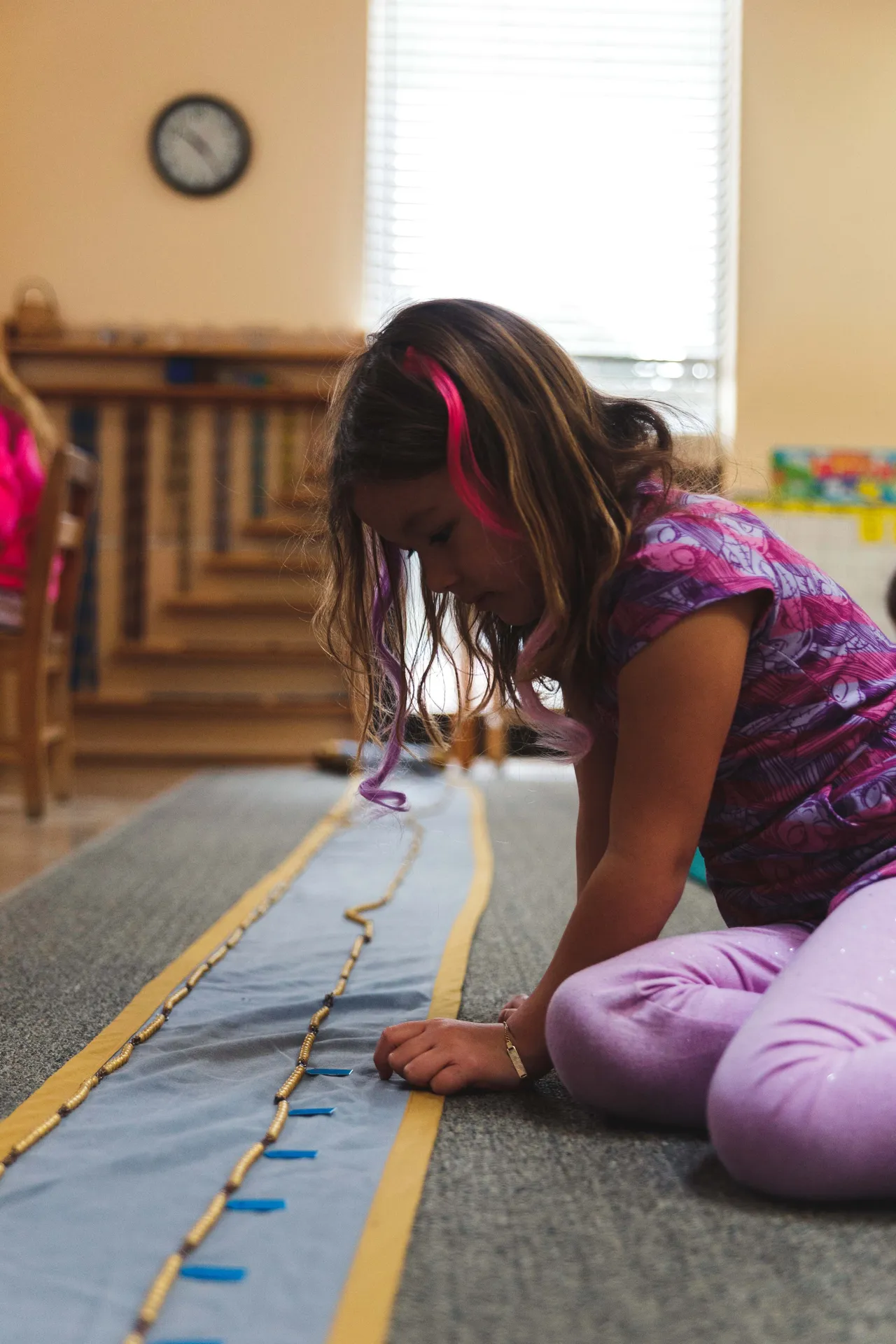
Montessori is a comprehensive, child-centered approach to education that supports all aspects of a child’s development. It is student-led and self-paced, without a prescribed curriculum. Instead, it emphasizes active learning, exploration, and discovery tailored to each child's individual needs and interests.
Rooted in scientifically validated principles of child development and refined over more than 100 years of practice, Montessori education is designed to align with the way children naturally learn and grow. The method builds on children’s instinct to work, focus, and engage in purposeful activity, with the what and how of learning guided by their developmental readiness.
Why It Matters
When children’s intrinsic needs are met, they learn willingly and with joy. Rather than relying on coercion or compulsion, Montessori environments are intentionally prepared to support independence, curiosity, and deep engagement, which allows learning to unfold naturally and meaningfully for each child.
Authentic Montessori
Authentic Montessori education is based on the principles and practices set forth by the Association Montessori Internationale (AMI). Maria Montessori founded AMI to maintain the integrity of her work and ensure rigorous teacher training.
MIR Head of School Jenny Davidson is on the AMI governing board, and MIR teachers hold AMI diplomas for their age groups.
The name "Montessori" is not trademarked or copyrighted. Therefore, any school can call itself "Montessori" without adhering to the Montessori method of education outlined by AMI.
Before deciding on a school for your child, we strongly recommend visiting the school and observing in the classroom to get a good sense of whether it is the right fit for your family.
Most Montessori schools, including MIR, are independent and unaffiliated with one another. You'll want to tour each school you are interested in individually to evaluate them for your family.
The Science of Montessori
A meta-analysis of 32 studies concluded that Montessori education has a meaningful and positive impact on children's academic and non-academic outcomes, relative to those observed with “traditional” educational methods.
What the Research Shows
Maitri Learning provides an exhaustive list of research for every age, for student populations ranging from low-income to deaf students, and even for the effectiveness of specific Montessori materials.
MIR highly recommends Montessori: The Science Behind the Genius, Third Edition by Angeline Lillard (2016, Oxford University Press). The book offers a thorough compilation of the scientific research into Montessori. It also looks at the distinctions between practices in standard education, pure "discovery learning" environments, authentic Montessori, and non-authentic Montessori education.
Evidence Brief – Ideal Learning Environments for Young Children provides a science-based description of what makes an ideal learning environment for young children. Montessori environments meet these criteria.
Additional Studies
- Does it work? What the Research Says. (National Center for Montessori in the Public Sector, 2016). This version provides an annotated bibliography of the research.
- Math achievement outcomes associated with Montessori education. (Early Child Development and Care, 1-12, Winter 2021)
- Beyond executive functions, creativity skills benefit academic outcomes: Insights from Montessori education. (PLOS One, November 2019)
- An Association Between Montessori Education in Childhood and Adult Wellbeing. (Frontiers in Psychology, 5351, January 2020)
- The Evidence Base for Improving School Outcomes by Addressing the Whole Child and by Addressing Skills and Attitudes, Not Just Content. (Early Education and Development, 2: 780-793, September 2010)
- Preschool Children's Development in Classic Montessori, Supplemented Montessori, and Conventional Programs. (Journal of School Psychology 50:379-401, June 2012)
- Montessori Preschool Elevates and Equalizes Child Outcomes: A Longitudinal Study. (Frontiers in Psychology, October 2017)